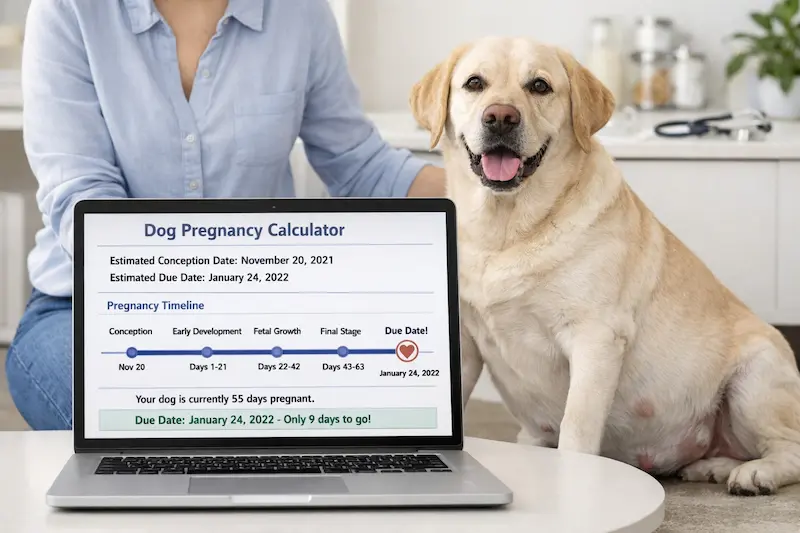
Dog Pregnancy Calculator: Estimate Your Dog’s Due Date
A dog pregnancy calculator estimates a dog’s due date based on the breeding or ovulation date. Enter the mating date to get an expected whelping window, usually around 63 days. It helps owners track milestones, prepare supplies, and plan delivery.
Understanding the pregnancy schedule early can reduce stress, organize supplies, and ensure the mother and puppies stay healthy throughout the gestation period.
Need a quick estimate? Use our Dog Pregnancy Due Date Calculator to calculate your dog’s expected delivery date.
What Is a Dog Pregnancy Calculator?
A dog pregnancy calculator is a simple tool that predicts when your dog may give birth. You enter the mating or ovulation date, and the tool estimates the due date based on the average canine gestation period. Most dogs are pregnant for about 63 days from ovulation, though small variations are normal.
This tool is helpful for breeders and pet owners who want a clear schedule for vet visits, nutrition changes, and whelping preparation.
How Does a Dog Due Date Calculator Work?
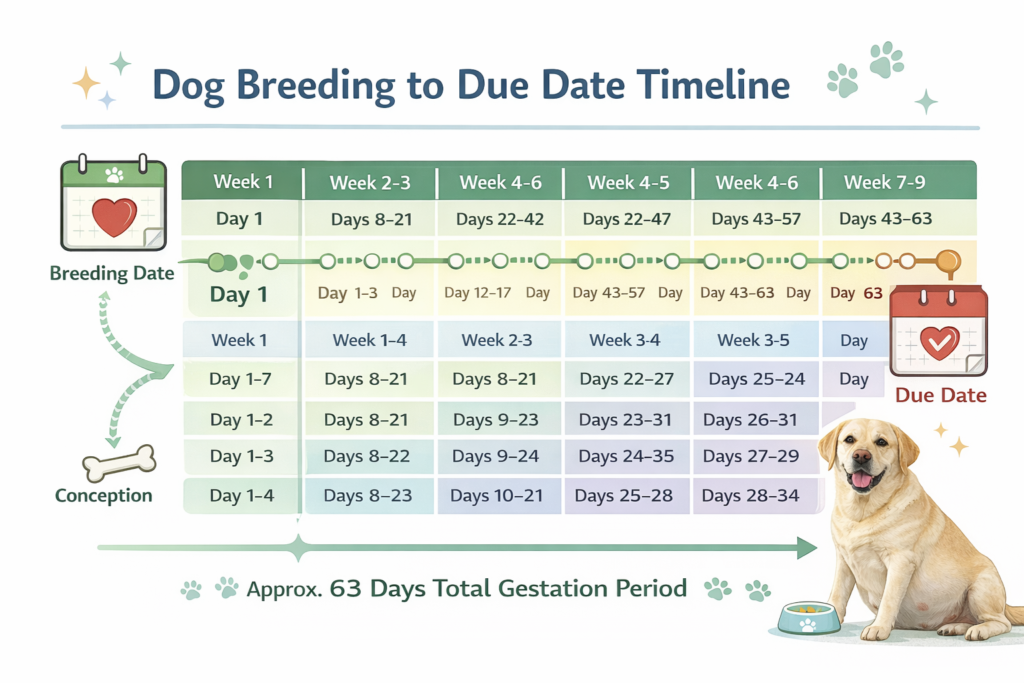
The calculator adds the average gestation length (about 63 days) to the ovulation or breeding date. Ovulation-based dates are more accurate because sperm can live inside the female for several days before fertilization occurs. This means puppies may be conceived later than the mating date suggests.
Using ovulation timing gives the most reliable estimate of the whelping window.
How Long Are Dogs Pregnant?
Dogs are typically pregnant for 58 to 68 days, with 63 days from ovulation being the average. Breed size does not change gestation length, but litter size and individual health can slightly affect delivery timing.
Most healthy dogs give birth around the 9-week mark.
According to the American Kennel Club, dogs are typically pregnant for approximately 62 to 64 days, though timing can vary by breed, individual health, and when ovulation occurred.
If you are specifically researching large breeds, see our detailed guide on How long are German Shepherd dogs pregnant?
What Is the Average Dog Gestation Period?
The average gestation period is 63 days from ovulation.
From mating, it may appear longer because ovulation does not always happen on the same day as breeding.
| Reference Point | Average Length |
| From Ovulation | 63 Days |
| From Mating | 58 to 68 Days |
Is Ovulation Date More Accurate Than Mating Date?
Yes. Ovulation testing, usually done through progesterone testing, provides a more precise pregnancy timeline. Mating dates are less reliable because fertilization can happen a few days after breeding. For breeders seeking accuracy, ovulation timing is the best reference point.
What Happens Each Week of Dog Pregnancy?
A dog’s pregnancy develops in clear stages. Early weeks often show very few visible signs, while the final weeks bring noticeable physical and behavioral changes. Tracking weekly progress helps owners prepare for each stage of development.
Puppy Development Week by Week:
| Week | Development Stage |
| 1 to 2 | Fertilization and cell division |
| 3 to 4 | Embryos attach; heartbeat forms |
| 5 to 6 | Puppies develop organs and limbs |
| 7 to 8 | Rapid growth; skeleton hardens |
| 9 | Puppies move into the birth position |
When Can Puppies Be Detected?
Days 21 to 28: Ultrasound can confirm pregnancy and detect heartbeats.
Days 28 to 35: A veterinarian may feel puppies through gentle palpation.
Day 45+: X-ray clearly shows skeletons and helps count puppies accurately.
What Are the Early Signs of Dog Pregnancy?
Early signs are often subtle and easy to miss. Common changes include:
- Slight appetite changes
- Mild weight gain
- Enlarged or pink nipples
- Reduced activity
- Increased affection or calm behavior
Most signs become clearer after week four.
Also Read: Signs a German Shepherd Is Pregnant
What Hormone Changes Occur During Pregnancy?
Progesterone rises after ovulation and remains elevated throughout pregnancy to support fetal development. Hormonal changes also prepare the body for milk production before birth. These shifts can influence appetite, behavior, and energy levels.
What Is False Pregnancy in Dogs?
False pregnancy occurs when a dog shows pregnancy-like symptoms without carrying puppies. It happens due to hormonal changes after heat. Dogs may nest, produce milk, or show maternal behavior. This condition usually resolves on its own, but should be monitored if symptoms are severe.
How Is Ultrasound Used to Confirm Pregnancy?
Ultrasound confirms pregnancy around day 25 by detecting fetal heartbeats. It helps determine if puppies are viable, but cannot reliably count litter size. It is one of the safest early confirmation methods.
Veterinary diagnostic methods such as ultrasound, hormone testing, and palpation are explained in detail by VCA Animal Hospitals, where ultrasound is noted as one of the most reliable ways to confirm pregnancy early (around 25 to 35 days)
How Does Palpation Confirm Pregnancy?
A trained veterinarian can gently feel the abdomen between days 28 and 35. Small fluid-filled sacs may be detected during this stage. After this window, palpation becomes less accurate as the uterus expands.
What Are Normal Progesterone Levels?
Before ovulation: Low (below 2 ng/mL)
At ovulation: Around 5 ng/mL
During pregnancy: Remains elevated
Testing progesterone levels helps identify the optimal breeding time and improves due-date accuracy.
What Should a Pregnant Dog Eat?
Feed a high-quality, nutrient-dense diet. During the second half of pregnancy, many vets recommend switching to puppy food because it provides more protein, calories, and essential nutrients for fetal growth. Fresh water should always be available.
Also Read: What Is Good Dog Food For German Shepherds?
How Many Calories Does a Pregnant Dog Need?
Calorie needs increase gradually.
Stage Calorie Increase
First 4 Weeks No major increase
Weeks 5 to 6 +10 to 20%
Weeks 7 to 9 +20 to 40%
Avoid overfeeding early in pregnancy to prevent unnecessary weight gain.
How to Prepare a Whelping Box?

- Choose a quiet, warm location
- Use clean, washable bedding
- Ensure low sides for easy access
- Introduce the mother 1to 2 weeks before delivery
Early preparation helps the dog feel safe and reduces stress before labor.
What Should a Whelping Kit Include?
- Clean towels
- Sterile scissors
- Heating pad
- Digital thermometer
- Vet contact number
Having supplies ready makes delivery safer and calmer.
What Behavioral Changes Happen Before Labor?
Many dogs show clear pre-labor behavior:
- Nesting
- Restlessness
- Seeking isolation
- Refusing food
- Increased panting
These signs usually appear within 12 to 24 hours of labor.
What Is Normal Temperature Before Whelping?
Normal temperature: 101 to 102.5°F (38.3 to 39.2°C)
It often drops below 100°F (37.8°C) about 12 to 24 hours before labor begins. Monitoring temperature helps predict delivery timing.
What Are the Signs of Dog Labor?
- Heavy panting
- Shivering
- Visible contractions
- Fluid discharge
- Active pushing
Puppy delivery typically begins soon after strong contractions start.
How Long Does Dog Labor Last?
Early labor can last 6 to 12 hours. Active delivery may take several hours, depending on litter size. Some dogs rest between puppies, which is normal as long as there is no distress.
What Are Emergency Signs Before Whelping?
- Strong contractions with no puppy for 30+ minutes
- Green discharge before the first puppy
- Extreme weakness
- Labor lasting over 24 hours
Immediate veterinary care is necessary in these situations.
When Is Vet Help Needed During Delivery?
Contact a vet if you notice:
- A puppy stuck in the birth canal
- More than 2 hours between puppies
- Excessive bleeding
- Signs of distress or pain
Quick action can save lives.
How Many Puppies Can a Dog Have?
Litter size depends on breed and genetics. Small breeds may have 1 to 4 puppies, while large breeds can have 6 to 12 or more. First-time mothers often have smaller litters.
How Is Litter Size Predicted?
Ultrasound helps confirm viability.
X-ray after day 45 provides the most accurate puppy count.
Breed history also gives general expectations.
What Complications Occur During Gestation?
Possible complications include:
- Dystocia (difficult birth)
- Eclampsia (low calcium)
- Miscarriage
- Infections
Regular vet visits greatly reduce risks.
Large breeds may also be prone to serious health risks, such as bloat in German Shepherds, which requires immediate veterinary care.
How to Care for a Dog After Birth?
- Provide fresh water and high-calorie food
- Keep bedding clean
- Monitor temperature daily
- Ensure puppies are nursing
- Watch for signs of infection
Close monitoring during the first week is essential.
Why Is Postpartum Care Important?
The first two weeks after birth are critical for both the mother and puppies. Careful observation helps prevent infections, milk problems, and puppy loss. Proper nutrition, hygiene, and rest ensure a healthy recovery and strong litter.
FAQ’s:
How accurate is a dog pregnancy calculator?
A calculator gives an estimated due date based on average gestation (about 63 days). Accuracy improves when you use the ovulation date instead of the mating date.
Can I use a dog pregnancy calculator after one mating?
Yes, enter the mating date to get an estimated whelping window, but remember puppies may be conceived a few days later.
Do all dogs give birth exactly on day 63?
No, Most dogs deliver between day 58 and 68, so the calculator provides a range rather than an exact day.
Can a dog pregnancy calculator replace a vet check?
No, it only estimates the due date and timeline. Veterinary exams, ultrasound, and proper care are still necessary for a safe pregnancy.
Should I prepare a whelping box after using a due date calculator?
Yes. Once you know the expected window, start preparing the whelping area and supplies at least 1 to 2 weeks before delivery.
Conclusion:
A dog pregnancy calculator gives a simple way to estimate your dog’s due date and track pregnancy progress. When combined with proper nutrition, vet care, and preparation, it helps ensure a safe pregnancy and delivery. Planning allows owners to support both the mother and puppies through every stage of gestation and birth.